 Dogecoin
 lets you hold and send DOGE through wallets with different custody arrangements
Dogecoin is a peer-to-peer cryptocurrency whose wallets use private keys, secret credentials that authorize spending, to send DOGE payments. Choosing a wallet means deciding who controls those credentials and how you’ll recover access. A personal wallet gives you responsibility for its backup; a custodial account puts signing authority with a provider. DOGE can pay a willing recipient, fund a tip, or remain unspent. Before sending, the recipient’s address, network compatibility, and total debit need to be clear.
The short version: Wallet custody determines who can authorize DOGE payments, while the backup method determines how access survives a lost device.
Private keys and spending authority
A wallet manages the credentials needed to spend coins recorded on the blockchain, the network’s shared transaction ledger. Its displayed balance summarizes coins associated with those credentials. An address gives someone a destination for a payment. The corresponding private key supplies spending authority, so sharing a receiving address and sharing a private key have entirely different consequences.
Custody determines who exercises that authority. With a personal wallet, losing every usable backup can mean losing access. With a custodial account, the provider controls the keys and handles withdrawal requests. Account access therefore depends on the provider as well as your login credentials.
Wallet setups and their operating requirements
Wallet choices differ in key storage, transaction verification, and recovery requirements, even when they handle the same native DOGE. The configurations below overlap: a hardware device, for instance, commonly works alongside a desktop or mobile application. Device format alone doesn’t establish custody.
| Wallet arrangement | Control of signing keys | Operating requirement |
|---|---|---|
| Dogecoin Core wallet | Local wallet keys under your control | Downloads and validates blockchain data |
| Self-custody light wallet | Keys remain under your control | Uses full nodes without storing the entire blockchain |
| Self-custody mobile wallet | App manages your local keys | Needs compatible native DOGE support and its specified backup |
| Hardware wallet | Device signs internally | Needs DOGE-compatible device software and a transaction interface |
| Paper wallet | Holder controls the recorded private key | Needs compatible software to spend; paper alone cannot broadcast |
| Custodial exchange account | Provider holds signing keys | External transfers depend on available withdrawals |
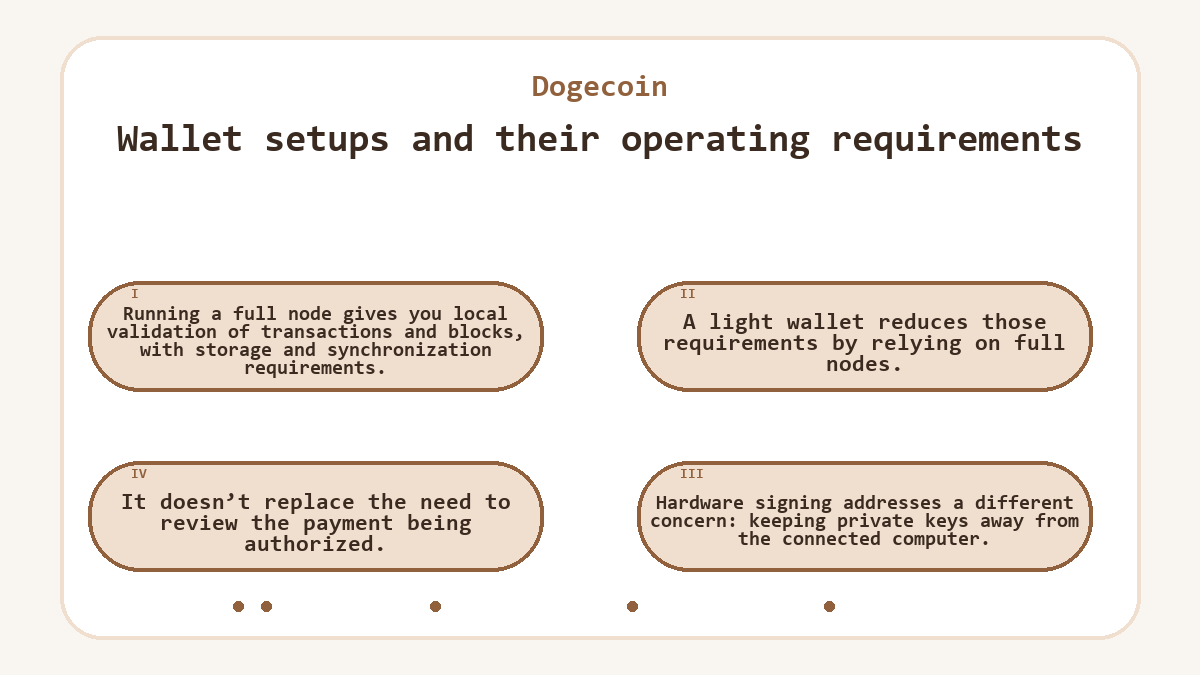
Running a full node gives you local validation of transactions and blocks, with storage and synchronization requirements. A light wallet reduces those requirements by relying on full nodes. Hardware signing addresses a different concern: keeping private keys away from the connected computer. It doesn’t replace the need to review the payment being authorized.
Can a DOGE payment be canceled?
An unsigned DOGE payment draft can be discarded, but a broadcast transaction has no guaranteed cancellation path. Keep the payment uncommitted while checking the destination and total amount. Some wallet actions combine signing and broadcasting, so signing isn’t always a separate review stage.
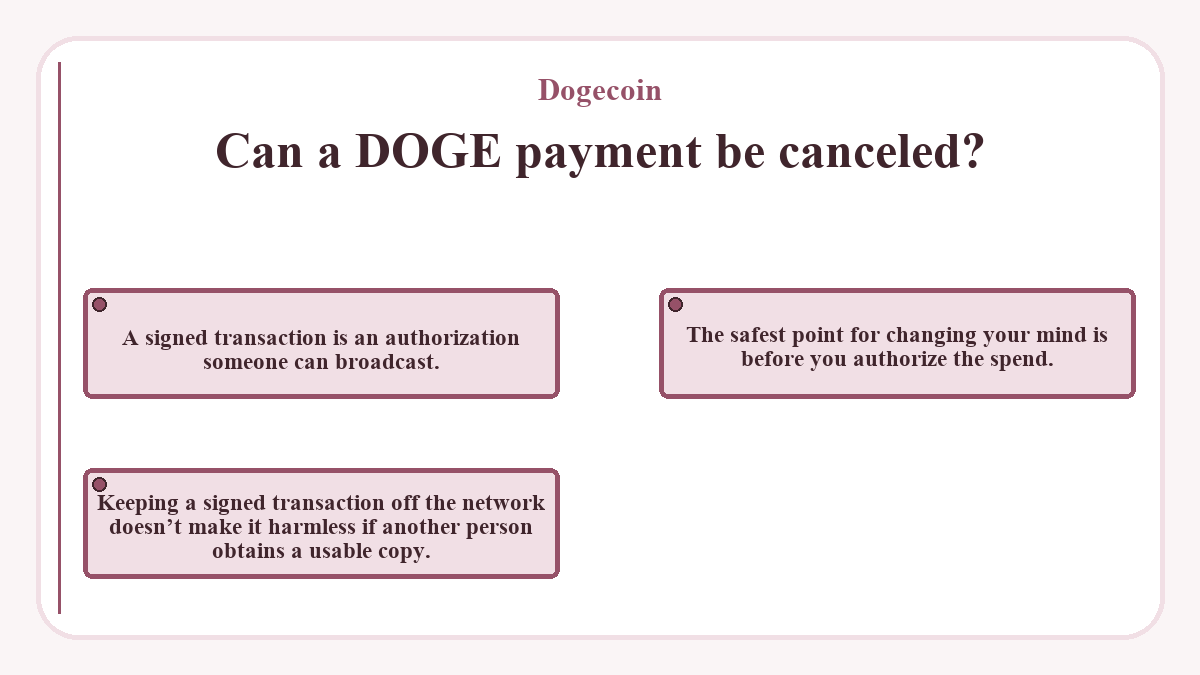
A signed transaction is an authorization someone can broadcast. Keeping a signed transaction off the network doesn’t make it harmless if another person obtains a usable copy. The safest point for changing your mind is before you authorize the spend.
An unconfirmed status doesn’t guarantee a chance to undo the payment. A miner may include the transaction before any attempted replacement takes effect. Replacement behavior also depends on the transaction, wallet support, and network policies.
A confirmed payment has no sender-controlled undo function. Returning funds requires a separate transaction authorized by whoever controls the receiving coins.
Receiving DOGE and selecting the network
Receiving native DOGE requires a compatible receiving address, whether the coins arrive through a purchase, payment, gift, or tip. An exchange purchase may initially appear only as an account balance. Moving it into a personal wallet requires an external withdrawal to that wallet’s address. The provider’s withdrawal availability is separate from the blockchain’s ability to process payments.
Both ends must support the same network. A token carrying a similar name on another blockchain isn’t automatically spendable as native DOGE. Match the sender’s network selection to the receiving wallet’s supported network before authorizing a transfer. A QR code can carry the destination address, reducing manual entry, but it doesn’t establish that the destination belongs to the intended recipient.
Transaction size, fees, and change
A DOGE network fee reflects the transaction’s data size and applicable wallet, relay, and mining policies. It isn’t simply a percentage of the amount sent. Fee settings are configurable, and a provider’s withdrawal charge can differ from the fee its transaction pays to miners. The payment review should make the total debit and intended recipient amount understandable before authorization.
The network tracks spendable amounts as unspent transaction outputs, or UTXOs. A payment consumes selected outputs and creates new ones. Any remaining value generally returns to the sender as change after the fee. Combining many small outputs can increase transaction size. Very small outputs also encounter dust policies, which discourage uneconomically small payments; a wallet may reject them or add tiny change to the fee.
Confirmation and recipient acceptance
Confirmation means a transaction has entered a block accepted by the network, rather than merely appearing in a wallet’s pending activity. Later blocks increase its confirmation count. Mining and transaction inclusion don’t follow a guaranteed deadline, and recipients can require different confirmation thresholds. A receiving service may also need to credit its own account records after the blockchain requirement is met. Check that the payment is recorded on-chain and meets the recipient’s acceptance requirements, including any required account credit.
A payment record should match the intended address and amount. A transaction identifier alone doesn’t establish either match or confirmation.
Public payment records and protected credentials
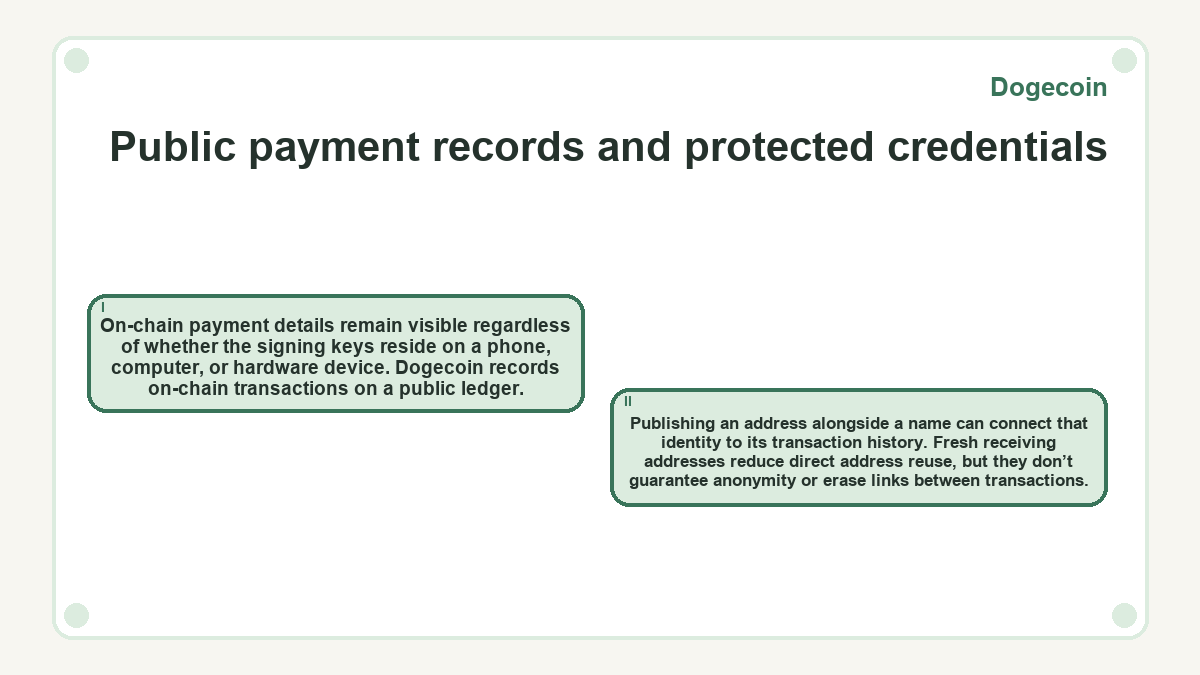
On-chain payment details remain visible regardless of whether the signing keys reside on a phone, computer, or hardware device. Dogecoin records on-chain transactions on a public ledger. Publishing an address alongside a name can connect that identity to its transaction history. Fresh receiving addresses reduce direct address reuse, but they don’t guarantee anonymity or erase links between transactions.
Hardware wallets isolate signing keys when the device functions as intended and hasn’t been compromised. They don’t conceal public transfers. A recovery phrase is another route to the same spending authority, so its protection matters even when the device itself remains secure.
Mining, issuance, and the coins you hold
Mining adds blocks through Scrypt proof of work, while ordinary wallets authorize payments using coins already available to spend. Miners receive newly issued DOGE and transaction fees for accepted blocks. Running a regular full node validates and relays network data; it doesn’t automatically earn mining rewards. Holding coins, operating a node, and mining are separate activities with different requirements.
The issuance schedule has no fixed terminal supply cap. New coins enter circulation through block rewards, rather than appearing in every holder’s wallet. That supply mechanism doesn’t determine a future exchange price. A balance stated in DOGE can stay unchanged while its purchasing power changes. Spending also requires a willing recipient: payment capability alone doesn’t establish merchant acceptance.
Backups and access after a device change
Recovery depends on the wallet’s actual backup format, which may be a wallet file, exported keys, or a recovery phrase. These formats aren’t interchangeable across every application. Phrase-based recovery can also depend on compatible derivation settings and an optional passphrase. A replacement device is useful only when the available backup can recreate the credentials controlling the coins.
File-based wallets need particular attention when new keys enter use. An older backup may omit keys associated with later receiving or change addresses. Keep backups aligned with the wallet’s own recovery requirements, and retain the password needed for an encrypted backup. Dogecoin Core’s wallet.dat is one such file to protect.
Questions worth asking
Can I receive DOGE while my wallet is offline?
A valid receiving address can receive DOGE while your wallet is offline. The network records the payment without requiring your device to stay connected. Your application needs updated blockchain information before it can display the new activity accurately. Keeping the device offline doesn’t remove the need to preserve the private keys or backup controlling that address.
Will using the same private keys in two wallets double my balance?
Using the same private keys in two compatible wallets gives both access to the same coins. Each application reads the same underlying holdings, so their displayed balances aren’t separate amounts you can add together. A spend authorized through either application affects the shared holdings. Differences between their displays can reflect synchronization or how they classify unconfirmed funds.
Does holding DOGE in a wallet earn staking rewards?
Holding native DOGE doesn’t earn protocol staking rewards because the network uses proof of work. A service advertising a yield introduces a separate arrangement, with its own custody, withdrawal, and payment conditions. Such an offer isn’t a reward the blockchain automatically pays for leaving coins in an ordinary wallet.
What happens if I forget my encrypted wallet’s password?
An encrypted wallet backup generally requires its password before you can use the protected private keys. Restoring that same file on another computer doesn’t remove its encryption. A separate usable key backup or compatible recovery phrase may provide another access route if the wallet supports one and you saved it. An account password reset doesn’t unlock a personal encrypted wallet file.
Is a wallet balance always available to spend immediately?
A displayed balance can include amounts the wallet doesn’t yet treat as spendable. Confirmation filters and wallet rules affect which outputs it makes available for a transaction. A read-only wallet can also display holdings without possessing signing keys. The total shown on screen therefore needs to be distinguished from the amount the application can actually authorize.
Do I need real DOGE to test a wallet integration?
Dogecoin Core supports separate testing environments that don’t require spending real mainnet DOGE. Testnet connects to a test network, while regtest supports controlled local testing and block creation. Their coins and transaction records belong to those environments. A successful test doesn’t move funds on the main network or establish that a production service will accept the same operation.