 Dogecoin
 transaction IDs connect payment records to their confirmation status
Dogecoin transaction IDs let you locate a transfer and inspect its outputs and block confirmations. Copy the ID from the sending record, then compare the returned destination and amount with the expected payment. An ID alone doesn’t establish broadcast, confirmation, or credit to a recipient’s account.
The short version: A transaction ID identifies the payment record; its outputs and confirmation depth show whether it meets the expected destination, amount, and confirmation requirements.
Blockchain transfers and account records
A blockchain lookup requires the transaction hash for an actual network transfer. A withdrawal request number identifies a provider’s internal record and may exist before the provider broadcasts anything. Where a service supplies both identifiers, their labels and purposes matter. Searching an internal reference won’t reveal a blockchain transaction.
The transaction also needs to belong to the network you’re inspecting. Mainnet and test networks maintain separate histories, so an unsuccessful search on one doesn’t establish absence from another. Transfers recorded entirely within a custodial service may have no corresponding individual blockchain transaction. In that situation, the service’s account history supplies the relevant payment record.
The identifier and the transaction it describes
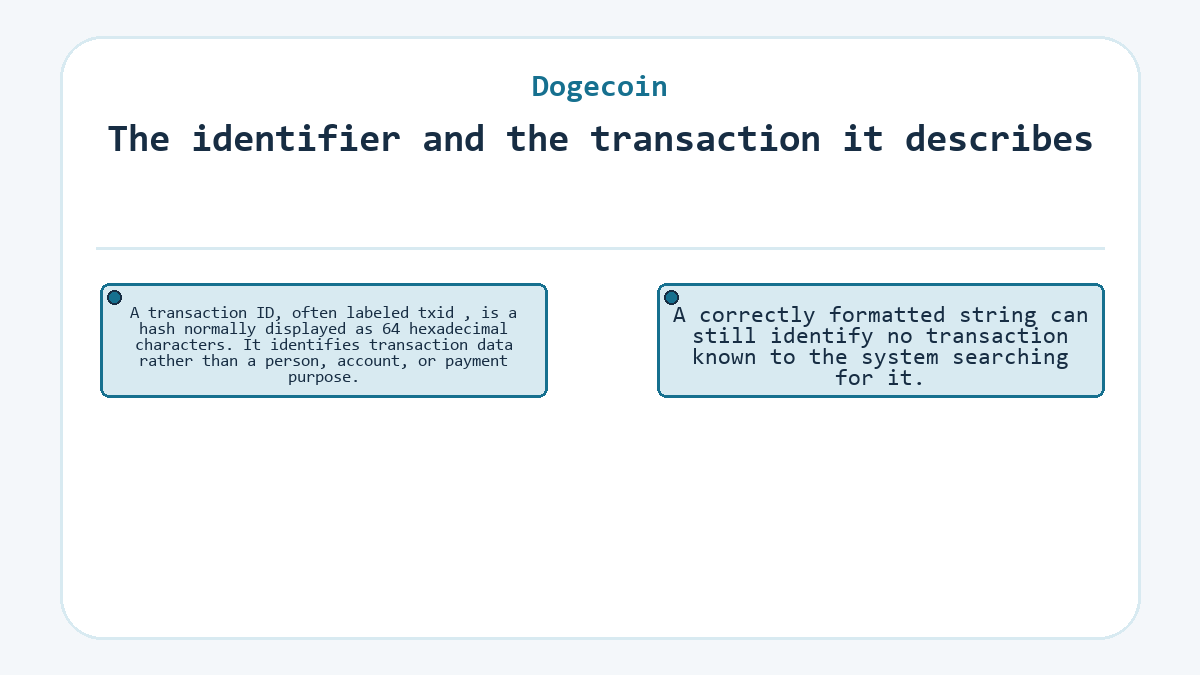
A transaction ID, often labeled txid, is a hash normally displayed as 64 hexadecimal characters. It identifies transaction data rather than a person, account, or payment purpose. A correctly formatted string can still identify no transaction known to the system searching for it.
Copy the complete identifier rather than a shortened display. A receiving address and a block hash serve different purposes, even though all can appear beside the same transfer. The transaction contains inputs referencing earlier outputs and new outputs specifying values and spending conditions. One transaction can therefore cover several payments. Its identifier doesn’t tell you which output belongs to your payment until you inspect those details.
Why can’t a lookup find my transaction?
A missing result means the lookup system couldn’t retrieve that identifier from the transaction data available to it. Possible causes include an incorrect ID, the wrong network, an unbroadcast transaction, or a lookup service whose data hasn’t caught up. A local node’s indexing configuration can also limit historical searches.
Absent from a public lookup
An explorer reports its own view of the network. Its search result doesn’t establish what every node has received. Compare the complete hash and selected network with the sending record before interpreting absence as a failed payment. A sender’s local record may contain a transaction the explorer hasn’t received.
Absent from a local node query
A node can validate blocks without maintaining a general transaction index for historical searches. Consequently, a query failure can describe the lookup configuration rather than the payment. Wallet queries and general transaction queries have different coverage; choosing between them depends on whether the transaction belongs to the loaded wallet.
Unconfirmed records and network acceptance
An unconfirmed transaction isn’t included in a block in the node’s active chain. A mempool is a node’s collection of accepted transactions awaiting block inclusion. Presence there establishes that this node accepted the transaction under its rules; it doesn’t establish recipient acceptance or a deadline for confirmation.
Nodes can have different mempool contents because they receive transactions at different times and apply local policies. A wallet can also retain a record after its transaction disappears from the local mempool. These distinctions explain why an unconfirmed wallet entry and an empty explorer result can coexist. Mining supplies block inclusion, but a pending record alone doesn’t establish when a miner will include it.
Sending another payment solely because the first looks delayed can result in paying twice. Resolve the original transaction’s status before treating its absence from one display as permission to pay again.
What do transaction confirmations establish?
Confirmations describe a transaction’s depth in the active blockchain, starting with the block containing it. Subsequent blocks increase that depth while the containing block remains in the active chain. A recipient’s required confirmation threshold is a separate acceptance condition, so a confirmed transaction may still be awaiting acceptance.
For a transaction in the active chain, confirmations equal the current chain height minus its containing block’s height plus one. This relationship counts blocks, not elapsed minutes. Block arrival varies, so converting a confirmation requirement into a precise completion time would overstate what the count establishes.
A chain reorganization can change which blocks belong to the active chain and alter transaction depth. A saved confirmation count records an observation at a particular point. An acceptance decision needs the relevant current chain state.
Matching the payment to its outputs
A matching hash establishes which transaction you’re viewing; matching outputs establishes whether it contains the expected payment. Compare the destination and DOGE amount with the receiving instructions. A transaction total can include other recipients and change, so it isn’t automatically the amount your recipient received.
Recipient amount and output position
Each output has its own position within the transaction. Recording that position alongside the hash distinguishes individual outputs when a transaction includes several. For an ordinary address payment, inspect the destination associated with the relevant output and its value. A wallet’s net balance change may include effects beyond that single output.
Change and transaction fees
Change returns unused input value through another output. The network fee is the difference between total input value and total output value for an ordinary spending transaction. Neither change nor the fee should be mistaken for an additional payment to the intended recipient. Identifying change ownership may require wallet context beyond the public transaction record.
Wallet queries and indexed transaction searches
A wallet record and a general blockchain lookup answer overlapping questions through different stored data. The suitable path depends on the transaction’s relationship to the loaded wallet and the node’s configuration. Both require an adequately synchronized view before their confirmation information can support a payment decision.
Transactions known to the wallet
The gettransaction remote procedure call (RPC) in Dogecoin Core returns information about a transaction in the loaded wallet. Its response can include confirmation depth, transaction details, and wallet-specific information. It isn’t a universal search for every transfer on the network. A non-wallet transaction error therefore doesn’t establish that the transaction is absent from the blockchain.
General historical lookups
The getrawtransaction RPC provides transaction data, with decoded fields available through its verbose option. General historical lookup requires a transaction index; default lookup primarily covers mempool transactions, with limited exceptions for transactions with unspent outputs. An indexed node must finish the necessary indexing work before that path provides complete historical coverage.
A payment reconciled through the available query
In this hypothetical example, the sender’s synchronized wallet contains the payment, and its node lacks a general transaction index. The recipient has specified an acceptance threshold, represented by R confirmations. The expected receiving address and amount come from the payment instructions; no numerical amount or threshold is assumed.
The sender could inspect the loaded wallet with gettransaction or, on a node with a transaction index, use a general historical lookup through getrawtransaction. Either route must establish the same facts: the expected output exists, its amount matches, and its containing block has sufficient depth. Because general historical lookup isn’t available in this configuration, the sender uses the wallet record.
Suppose the returned transaction details match the expected destination and amount, and its confirmation count C is at least R. The payment meets the stated blockchain acceptance condition. The sender records the hash, matching output, and confirmation observation. If C were below R, the payment would remain short of that condition; changing the lookup method wouldn’t supply the missing confirmations.
Receipt records and unresolved account credit
A blockchain transfer can satisfy its confirmation requirement while a receiving service still shows no account credit. The transaction record establishes the destination and value on the network. The service’s records establish whether it assigned that deposit to the intended account. A matching transfer and an uncredited account therefore describe different stages of reconciliation.
A useful support record contains the transaction ID, relevant output, expected destination, amount, and the account reference supplied by the service. Keep any account-specific material within the support channel. A public hash exposes transaction details to anyone who looks it up, and attaching a name or account identifier can connect those details to a person.
Close the payment record when the required receipt or credit appears. Keep the transaction hash and relevant output position together so a later review can identify the same payment output.
Dogecoin: what people ask
Can a transaction timestamp prove exactly when DOGE was sent?
A displayed timestamp doesn’t necessarily identify the exact moment the sender broadcast the payment. Wallet receipt time, a service’s first observation, and the containing block’s timestamp describe different events. Check which field the display represents before using it to resolve a timing dispute. A block timestamp cannot establish when a receiving service credited an account.
Does searching for a DOGE transaction spend coins?
Reading a transaction record doesn’t create a blockchain transaction or consume a network fee. A lookup retrieves existing data without authorizing a payment. A provider may separately charge for access to its data service, but that charge is distinct from a DOGE transaction fee. Searching by hash doesn’t require a spending signature.
What do negative confirmations mean in a wallet response?
Negative confirmations in a wallet response indicate that the transaction conflicts with the blockchain. This differs from an ordinary unconfirmed transaction awaiting inclusion. Another transaction spending the same inputs can cause that conflict. Treat the affected record as conflicted rather than counting its value toward a successfully received payment.
Is a transaction ID the same as its block hash?
A transaction ID identifies one transaction, while a block hash identifies a block containing transactions. Several transaction IDs can therefore share the same containing block hash. When payment support requests the transaction ID, supplying only the block hash leaves it without the identifier needed to select your specific transaction.
Will rebroadcasting identical transaction data create another transaction ID?
Rebroadcasting exactly the same transaction data preserves its transaction ID. Broadcasting distributes the existing transaction rather than changing the data its hash identifies. Constructing or altering a transaction is different: changes to the transaction data used to calculate the ID can produce another hash. Retain the identifier corresponding to the transaction actually included in the blockchain.
Can a confirmed payment output appear as spent later?
A confirmed payment output can later appear as spent after another transaction uses it as an input. That status describes subsequent use of the received coins. It doesn’t erase the earlier payment or mean its original confirmation failed. For historical reconciliation, distinguish whether the payment occurred from whether its output remains available to spend.