 Dogecoin
 mining with Scrypt work and AuxPoW commitments
Dogecoin mining uses Scrypt proof of work to produce blocks, with AuxPoW allowing compatible mining work to secure its blockchain. Auxiliary proof of work binds a Dogecoin candidate block to work performed on a parent block. Acceptance requires a valid commitment and a hash meeting Dogecoin’s difficulty target. The chains retain separate transactions and rewards. For someone supplying hashpower, successful operation also means distinguishing accepted pool work from an accepted block and an eventual DOGE payout.
Table of contents
Scrypt work and separate difficulty targets
A qualifying hash must meet the target for the Dogecoin block under construction. Hashrate measures the rate of attempts; difficulty determines how demanding that target is. Dogecoin targets an average block interval of one minute and adjusts difficulty through DigiShield. Individual intervals vary. Merged mining doesn’t synchronize participating chains or require their targets to match. The same hashing attempt can qualify for one chain without qualifying for another, provided its commitments and other required data are valid.
How does AuxPoW bind mining work to a Dogecoin block?
AuxPoW connects the Dogecoin block hash to a parent block through a commitment and cryptographic inclusion proofs. The parent block supplies the Scrypt work the Dogecoin node checks.
The commitment inside the parent coinbase
A coinbase transaction is the special transaction a miner places at the beginning of a block. In merged mining, the parent coinbase contains a commitment covering the auxiliary block hash. A Merkle branch, a sequence of hashes proving inclusion, connects that commitment to the intended Dogecoin block. Another branch connects the parent coinbase to the parent header.
The commitment must exist before the corresponding hashing work. Changing the committed Dogecoin block changes the required commitment and the parent header being hashed. An unrelated solution can’t simply acquire a Dogecoin reward afterward.
Proof checks and block acceptance
Dogecoin’s AuxPoW validation checks that the auxiliary commitment appears in the parent coinbase. It also checks the inclusion branches and the chain-specific placement rules. A matching hash alone doesn’t repair a missing or incorrectly constructed commitment.
After checking the proof, nodes still apply Dogecoin’s block and transaction rules. An accepted block extends a branch of Dogecoin’s blockchain; its continued place in the active chain depends on subsequent consensus. Parent-chain activity doesn’t replace those checks.
What does an accepted pool share establish?
An accepted share records work credited under the mining pool’s rules. Pools use shares to account for participants’ contributions, while a network block must satisfy Dogecoin’s consensus requirements. A rising share count therefore isn’t a count of newly mined blocks or completed payments. The pool’s reward method determines how credited work contributes to earnings. Its payout conditions determine when an account balance becomes a transfer to the miner’s wallet.
Block rewards, maturity, and payout accounting
Mining revenue passes through different rules depending on whether you’re receiving a block’s coinbase output or a pool payment. Those records describe different claims on funds.
The subsidy and included transaction fees
Dogecoin’s ongoing block subsidy is 10000 DOGE per block. The block reward can also include fees from its transactions. A pool participant receives the amount determined by the pool’s distribution rules, rather than that entire subsidy for every accepted share. Merged mining doesn’t multiply Dogecoin’s subsidy because additional chains participate.
Coinbase maturity and pool balances
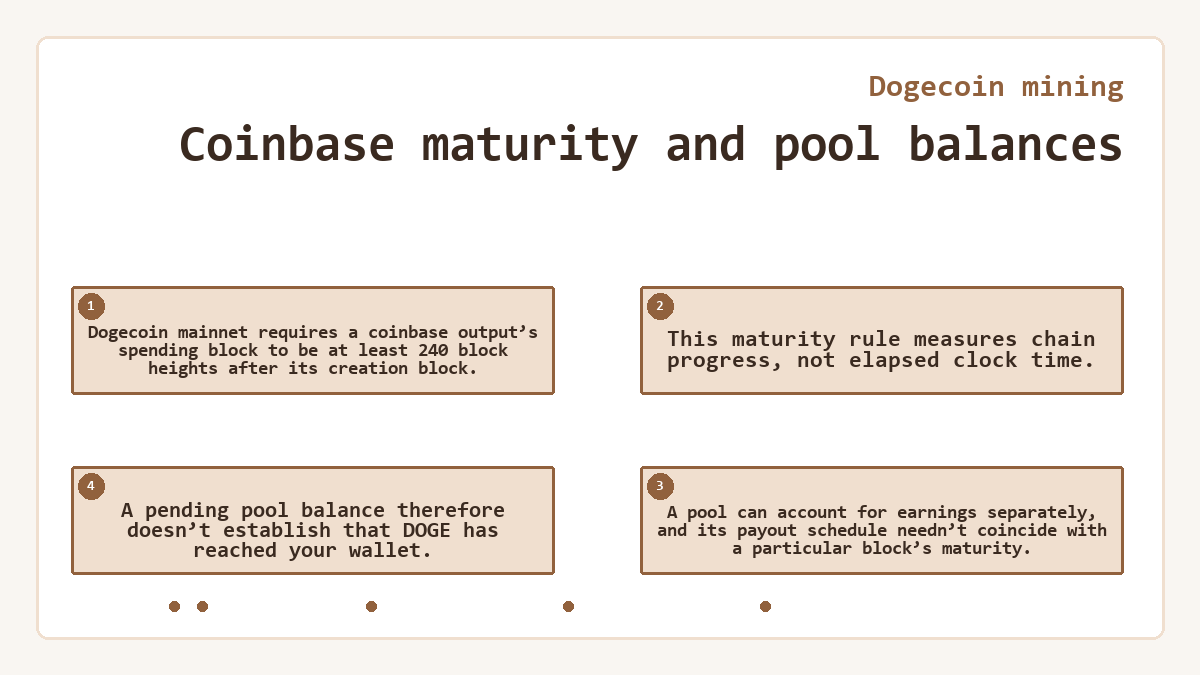
Dogecoin mainnet requires a coinbase output’s spending block to be at least 240 block heights after its creation block. This maturity rule measures chain progress, not elapsed clock time. A pool can account for earnings separately, and its payout schedule needn’t coincide with a particular block’s maturity. A pending pool balance therefore doesn’t establish that DOGE has reached your wallet.
Scrypt hardware and operating costs
A mining device must support the required Scrypt work and communicate with compatible mining software or a pool. Application-specific integrated circuits, usually called ASICs, perform this specialized hashing. Compatibility establishes whether the equipment can do the work; it doesn’t establish whether operating it will cover its costs. Power supply requirements, heat removal, ventilation, and noise all affect whether a proposed installation is workable.
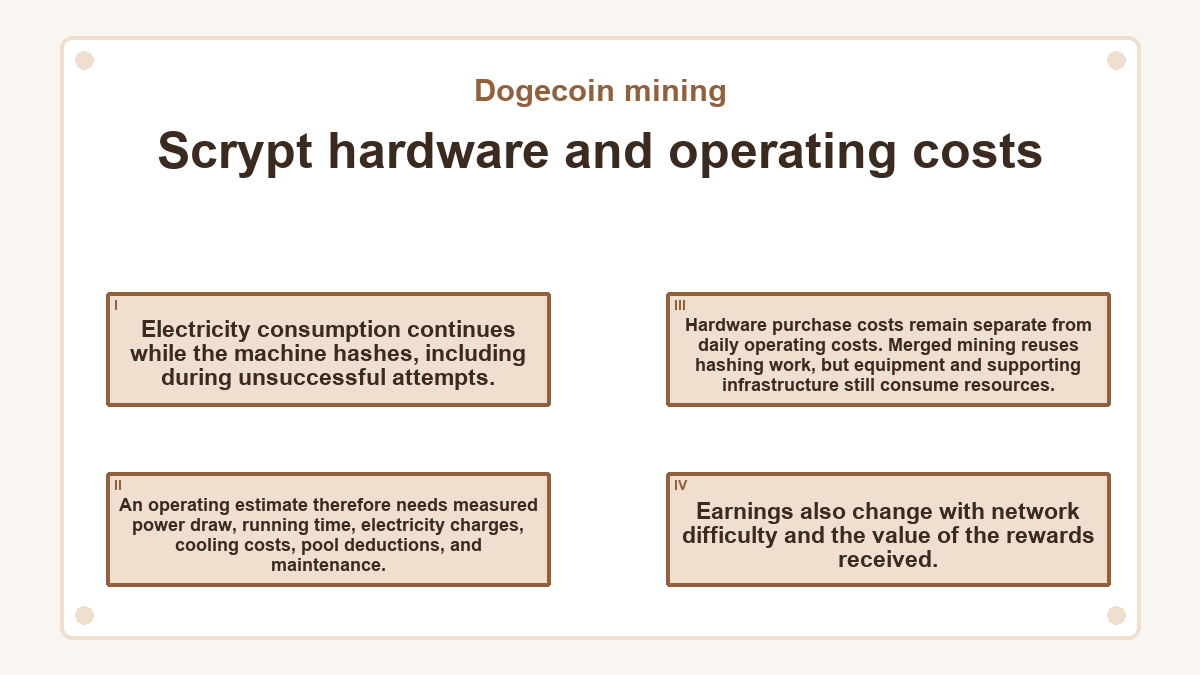
Electricity consumption continues while the machine hashes, including during unsuccessful attempts. An operating estimate therefore needs measured power draw, running time, electricity charges, cooling costs, pool deductions, and maintenance. Hardware purchase costs remain separate from daily operating costs. Merged mining reuses hashing work, but equipment and supporting infrastructure still consume resources. Earnings also change with network difficulty and the value of the rewards received.
Can a rejected AuxPoW submission be repaired?
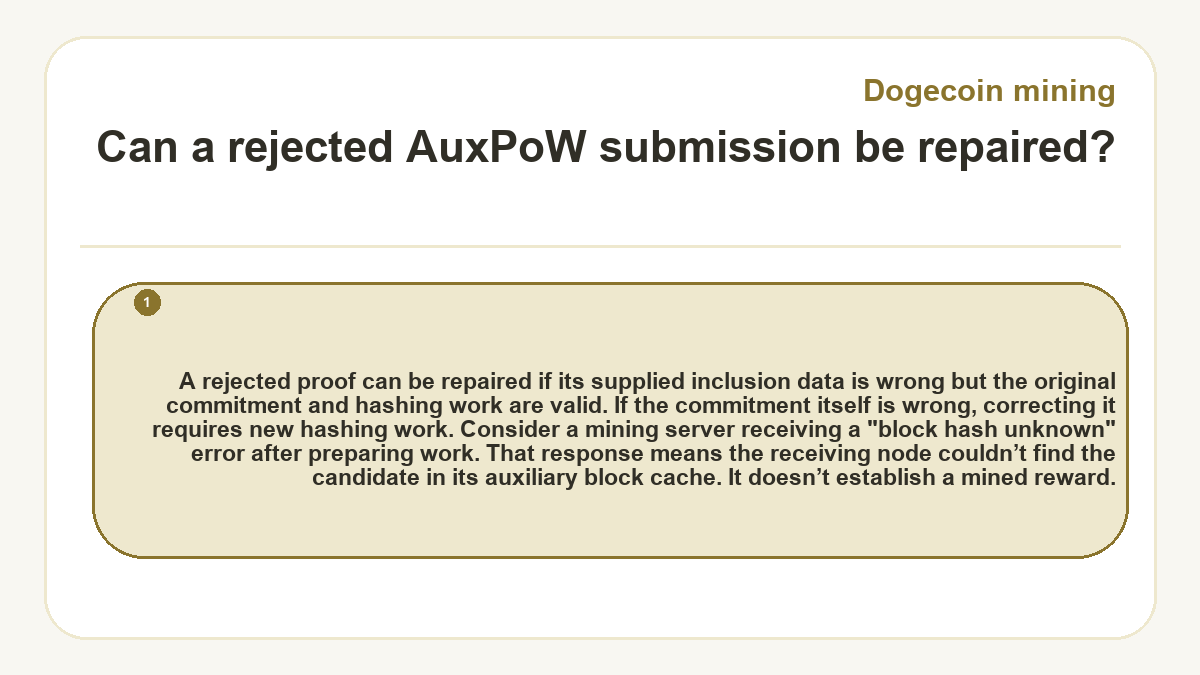
A rejected proof can be repaired if its supplied inclusion data is wrong but the original commitment and hashing work are valid. If the commitment itself is wrong, correcting it requires new hashing work. Consider a mining server receiving a "block hash unknown" error after preparing work. That response means the receiving node couldn’t find the candidate in its auxiliary block cache. It doesn’t establish a mined reward.
Before committing more hashing work, use these conditions to decide whether the candidate remains usable:
- Confirm the Dogecoin node has peers and has completed its initial block download.
- Check whether the submitting node still knows the candidate hash.
-
If the candidate is unknown, obtain a fresh candidate through
createauxblockand rebuild its parent commitment. - Check the coinbase destination before hashing; changing it requires a different candidate and corresponding work.
-
Submit a qualifying proof with
submitauxblock, then reconcile the response with the block’s active-chain status.
The candidate can be discarded before submission. Once a block enters the network, its producer has no private edit or recall control. Successful submission establishes a validation outcome; continued active-chain inclusion and coinbase maturity govern the resulting reward. Replacing an obsolete candidate doesn’t recover electricity already spent hashing it.
Solo operation and pooled merged mining
Solo mining and pool participation differ in who coordinates the work and how rewards reach the participant. Operating independently requires handling candidate construction, proof submission, and node availability. A pool performs those coordinating functions for its participants and distributes earnings under its own rules. Pooling can smooth individual receipts, while adding reliance on the operator’s accounting and payment arrangements.
AuxPoW describes how the network accepts compatible work. Pool membership describes how miners organize and share proceeds. Neither term establishes the other’s configuration.
The next choice is whether to operate the merged-mining infrastructure or contribute work to an existing pool. For a pool, examine whether its jobs actually include Dogecoin, how it allocates DOGE rewards, and what must happen before payment. For independent operation, the requirements include compatible hashing equipment and software that constructs valid commitments and handles submissions.
Helpful answers
Does running a Dogecoin full node alone earn mining rewards?
Running a full node alone doesn’t earn a mining reward. A node validates and relays blockchain data; earning a block reward requires producing qualifying proof of work for a valid block. A mining setup may use a full node to construct and submit candidates.
Must the parent block confirm before Dogecoin accepts its AuxPoW?
Dogecoin doesn’t require confirmation of the parent block on another chain to validate its AuxPoW. It checks the supplied parent-header work against Dogecoin’s target and verifies the required commitments. The parent chain’s own acceptance requirements remain separate.
Is mining another cryptocurrency for a DOGE payout the same as merged mining?
Receiving DOGE after mining another cryptocurrency doesn’t by itself establish merged mining. A service may convert earnings into DOGE. Work contributes to Dogecoin through AuxPoW only when it includes the required Dogecoin commitment and produces a proof the network can validate.
What happens to a mining reward if its block leaves the active chain?
A coinbase reward from a block outside the active chain isn’t spendable as an active-chain output. A chain reorganization can therefore remove a previously visible mining reward. How a pool reflects that event in participant balances depends on its reward method and accounting rules.
How long will an individual miner wait to find a Dogecoin block?
An individual miner has no fixed waiting time. Finding a qualifying hash is probabilistic, and the expected wait depends on the miner’s hashrate and the applicable difficulty target. The network’s average block interval doesn’t guarantee a reward schedule for each machine.
Can Dogecoin merged mining continue if the node loses all its peers?
Dogecoin Core’s mainnet auxiliary mining interface rejects requests when its node has no connected peers. The hardware may remain powered, but that doesn’t establish successful candidate creation or submission. Restoring node connectivity is necessary for that interface to resume normal operation.